


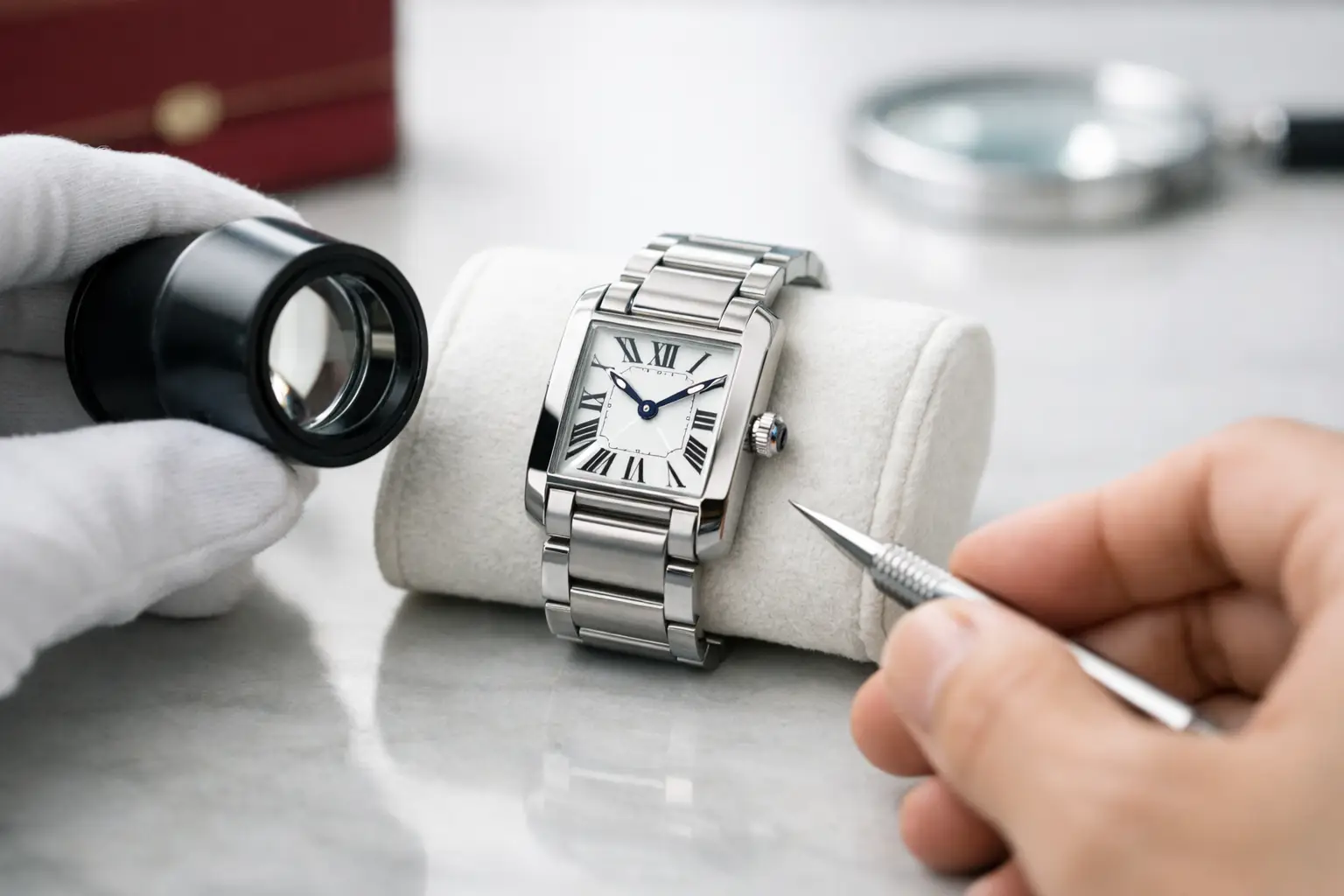
How to Authenticate a Cartier Watch
The fastest way to lose confidence in a luxury watch purchase is to notice one small detail that feels off after the deal is done. That is exactly why buyers ask how to authenticate a Cartier watch before they commit, not after. With Cartier, that caution is justified. The brand’s design language is iconic, widely recognized, and heavily copied, which means visual familiarity alone is never enough.
A convincing fake can get the broad strokes right. The case shape may look correct. The dial may carry the Cartier name. The seller may even present a box and papers. Authenticating a Cartier watch requires a closer standard – one that looks at construction, finishing, engravings, movement quality, and the credibility of the watch’s source as a whole.
How to Authenticate a Cartier Watch the Right Way
The first thing to know is that Cartier authentication is not a one-point test. There is no single engraving, secret mark, or serial number that proves authenticity on its own. Genuine Cartier watches reveal themselves through consistency. The dial, case, bracelet, crown, movement, and documentation should all align with the exact model, reference, and production era.
That matters because counterfeiters rarely fail in only one place. They usually miss several details at once – the font is slightly wrong, the caseback engraving is too deep, the blue cabochon looks cheap, the hands sit incorrectly, or the movement finishing does not match what Cartier used in that reference. A proper authentication process is about checking whether every part tells the same story.
Start With the Seller, Not the Watch
Before examining the watch itself, examine where it is coming from. This is the simplest way to reduce risk. A reputable luxury watch seller should be clear about authenticity, inspection standards, warranty coverage, condition disclosure, and whether the watch has a clean history.
If a seller avoids detailed photos, gives vague answers about service history, or relies on phrases like “looks authentic to me,” that is a problem. Serious Cartier inventory should be presented with confidence and precision. In the high-end secondary market, trust is not a marketing extra. It is part of the product.
Price is another early signal. Cartier watches can trade below retail on the secondary market depending on model and condition, but a dramatic discount usually means something is wrong. It could be counterfeit, heavily modified, stolen, or pieced together from non-original components. If the price feels far below market, assume there is a reason.
Documentation Helps, But It Is Not Proof
Original box, warranty card, receipt, and service records are all valuable. They support provenance and can make a watch more desirable. They do not, however, guarantee that the watch itself is genuine. Counterfeit packaging has improved, and authentic papers can become separated from the original watch.
Documents should match the watch in a meaningful way. Reference information, serial details, date ranges, and retailer information should make sense together. If the watch and paperwork do not align cleanly, pause there.
Examine the Dial Closely
The dial is one of the most revealing places to begin when learning how to authenticate a Cartier watch. Cartier is known for disciplined design. Printing should be crisp, evenly spaced, and refined under magnification. Smudged text, inconsistent font weight, uneven minute tracks, or sloppy numeral placement are common warning signs.
Many Cartier models include a hidden signature integrated into a Roman numeral on the dial. Buyers often treat this as the key authenticity marker, but it should be seen as one detail among many. Some genuine watches have it, some references vary, and counterfeiters now try to imitate it. Its presence alone does not confirm authenticity, and its absence does not always condemn a watch without further context.
Pay close attention to the hands as well. Cartier hand shapes are model-specific and proportion matters. On a Tank, Santos, Ballon Bleu, or Pasha, the hands should suit the case and dial architecture precisely. If the hands appear too short, too long, too thick, or poorly finished, that mismatch deserves scrutiny.
Case, Crown, and Engravings Should Feel Precise
Cartier cases are elegant, but they are not delicate in execution. Edges should be intentional, surfaces should transition cleanly, and the overall finish should feel exact. A counterfeit watch often looks acceptable in a listing photo but loses credibility in person when the polishing is uneven or the case proportions feel slightly inflated.
The crown is especially important on many Cartier models because of the signature blue cabochon. On an authentic watch, the stone or synthetic spinel should be set neatly and proportionately. It should not look glued in, oversized, cloudy, or loosely fitted. Counterfeits often exaggerate this detail because they know buyers look for it.
Caseback engravings should be sharp and appropriate for the model. Cartier engravings are usually clean, controlled, and consistent with the watch’s age and reference. Deep, crude, or poorly aligned markings are suspicious. So are generic engravings that do not match known Cartier conventions.
Check the Serial and Reference Numbers Carefully
Serial numbers matter, but they should be handled carefully. A serial number alone is not an authenticity certificate. Counterfeiters copy real serials, repeat numbers across multiple fake watches, or invent plausible-looking sequences.
The better question is whether the serial and reference markings are correctly formatted, correctly placed, and consistent with the exact Cartier model being offered. If a Santos has markings associated with a different generation, or a Tank carries an engraving style that does not match its era, that inconsistency matters more than simply seeing numbers on the caseback.
The Movement Tells the Truth
If there is one area where serious authentication becomes decisive, it is the movement. Cartier has used both in-house and sourced calibers over the years, but genuine movements still follow expected standards of finishing, layout, and fit. A fake movement may function, but it often looks rough, generic, or improperly secured inside the case.
This is where buyer limitations become clear. Most people cannot and should not open a watch themselves. Improper handling can damage the case, compromise water resistance, or create a dispute with the seller. For that reason, movement inspection is best left to a qualified watchmaker or trusted luxury dealer with experience in Cartier.
If a seller refuses professional inspection or becomes defensive when asked about movement verification, that is a meaningful red flag. A legitimate seller should welcome the scrutiny.
Bracelet, Strap, and Clasp Details Matter More Than Buyers Expect
A counterfeit Cartier watch often gives itself away through the bracelet or clasp before the dial does. On a Santos bracelet, for example, the screws, brushing, edge finishing, and integration with the case should feel exceptionally well executed. Rattling links, rough edges, poor screw alignment, or a lightweight feel can all point to a fake or heavily altered watch.
Leather straps are less decisive because they are often replaced over time, even on genuine watches. The clasp, however, deserves attention. Cartier deployants and buckles should have clean engraving, solid action, and proper finishing. A flimsy clasp on an otherwise expensive watch is never something to ignore.
Vintage Cartier Requires More Nuance
Not every irregularity means a watch is fake. Vintage Cartier pieces can be complicated. Dials may have aged. Straps may be replaced. Hallmarks and caseback styles can vary by market, workshop, or period. Some older watches also contain movements supplied by third-party specialists, which can confuse buyers who expect every authentic Cartier to look the same inside.
This is where context matters. A modern fake often looks wrong because it lacks discipline. A genuine vintage watch may look unusual because it is old, rare, or region-specific. When you are evaluating vintage Cartier, experience becomes much more important than checklists.
When to Walk Away
If several small concerns start to add up, trust that instinct. One issue may have an innocent explanation. Three or four usually do not. A questionable dial, inconsistent engraving, missing provenance, and a seller pushing urgency should be enough to end the conversation.
Luxury watch buying should feel selective, not pressured. The right Cartier watch will still need to prove itself. If it cannot hold up under careful review, it is not the right watch.
For buyers who want certainty rather than guesswork, the strongest protection comes from purchasing through a trusted source that authenticates inventory before it is offered for sale. That standard is what turns a high-value purchase from a risk into a confident acquisition.
Cartier should feel unmistakably refined in the hand and equally solid on paper. If any part of the watch or the transaction asks you to lower your standards, keep looking.



Comments are closed