


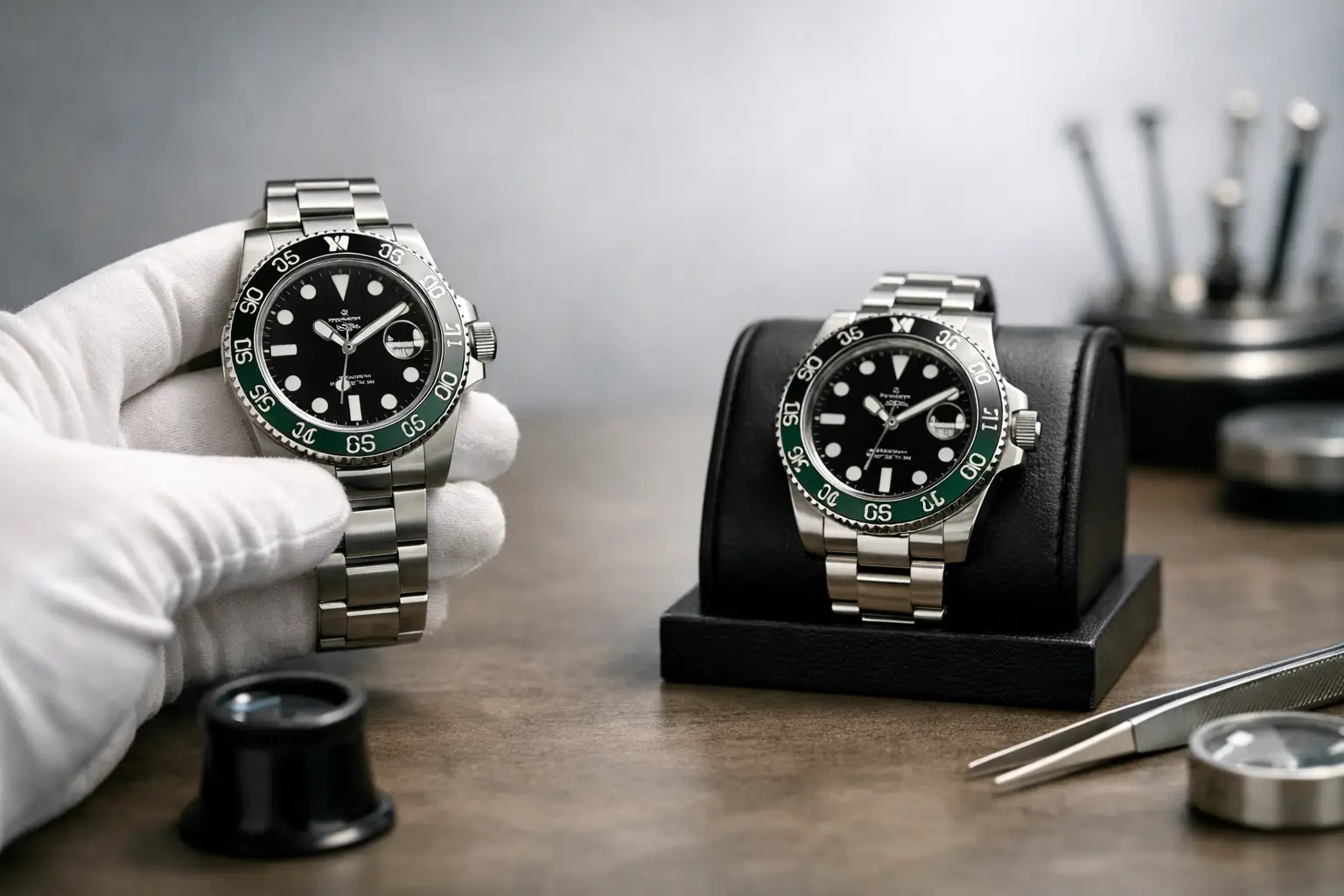
How to Tell Real Rolex Watches From Fakes
A counterfeit Rolex rarely gives itself away in one obvious moment. The risk is usually in the details – a dial that looks almost right, a case that feels slightly off, paperwork that appears convincing until you know what to question. If you are researching how to tell real Rolex watches from fakes, the safest approach is to look at the full picture, not a single feature.
That matters even more in the secondary market, where high-value purchases depend on trust. A fake can imitate branding. It cannot consistently match Rolex finishing, engineering, provenance, and quality control across every detail.
How to tell real Rolex watches from fakes at first glance
The first test is not technical. It is observational. Authentic Rolex watches present a very specific kind of precision. The case proportions are clean, the printing is crisp, the bracelet feels substantial, and the entire watch has visual balance. Counterfeits often fail here before you ever open the clasp.
A genuine Rolex should feel dense and refined in the hand. That does not mean every authentic piece is heavy in the same way, since materials differ across Oystersteel, gold, platinum, and two-tone references. It means the watch should feel intentional, not hollow, rattly, or loosely assembled. If the bracelet sounds tinny or the clasp feels flimsy, caution is justified.
You should also look closely at the dial. Rolex is obsessive about dial execution. Hour markers should be aligned, text should be sharp, and spacing should look exact. On a fake, the coronet can be slightly malformed, the font can appear too thick or too thin, or the minute track can look uneven under magnification. These are small flaws, but they are often the fastest path to doubt.
The movement tells the truth
One of the most misunderstood signs of authenticity is the second hand. Many people say a Rolex second hand never ticks. That is not quite right. A real Rolex automatic movement beats at a high rate, creating a smooth sweeping appearance rather than the one-second jump common in cheap quartz watches. It is fluid, not perfectly continuous.
If a supposed modern Rolex has an obvious quartz-style tick, something is wrong. There are rare historical exceptions in the brand’s past, but for the vast majority of Rolex watches buyers encounter, a jerky one-second motion is a serious red flag.
The date window is another useful checkpoint. On models with a Cyclops lens, the date should appear clearly magnified, typically around 2.5 times. Many fakes get this wrong. The magnification may be weak, the date may sit too far left or right, or the font may look off compared with the reference it is trying to copy.
If you can inspect the watch in person, set the time and date. The crown action on an authentic Rolex should feel precise and controlled. The hands should not wobble loosely, and the date change should operate with firmness. Counterfeit movements often feel rough, inconsistent, or overly light.
Engravings, serials, and case details
Rolex engravings are typically clean and sharply executed. Depending on the model and production year, you may find a serial number engraved on the rehaut or between the lugs, along with a reference number. These markings should look precise, not acid-etched, sandy, or poorly spaced.
The rehaut, which is the inner bezel ring between the crystal and dial, is a place where many counterfeiters struggle. On authentic examples, the engraved Rolex text is clean, evenly repeated, and properly aligned. The coronet at 12 o’clock should line up correctly with the dial marker. Misalignment here does not always prove a fake on its own, especially if parts have been replaced or photographs are poor, but it should never be ignored.
Caseback design can help too. Most Rolex models have a plain metal caseback. If you see an exhibition caseback on a standard modern Submariner, Datejust, GMT-Master II, or Daytona, that is an immediate reason to investigate further. There are rare exceptions in vintage and special-piece contexts, but transparent casebacks are not normal on mainstream Rolex production.
How fakes fail on finishing
Rolex finishing is expensive to replicate because it is not just about shine. It is about consistency. Brushed surfaces should have an even grain. Polished areas should be smooth and reflective without distortion. Edges should feel deliberate, not soft where they should be crisp or sharp where they should be refined.
Look at the bracelet links and clasp closely. On an authentic Rolex, tolerances are tight. The clasp should close with confidence. The bracelet should drape with substance, not looseness. Modern counterfeit watches can imitate the overall look surprisingly well in photos, but they often lose credibility the moment they are handled.
Lume is another subtle indicator. On a genuine Rolex, luminous material should be evenly applied and consistent across markers and hands. Uneven color, sloppy application, or mismatched glow can indicate poor replacement parts or outright forgery.
Box and papers help, but they do not guarantee authenticity
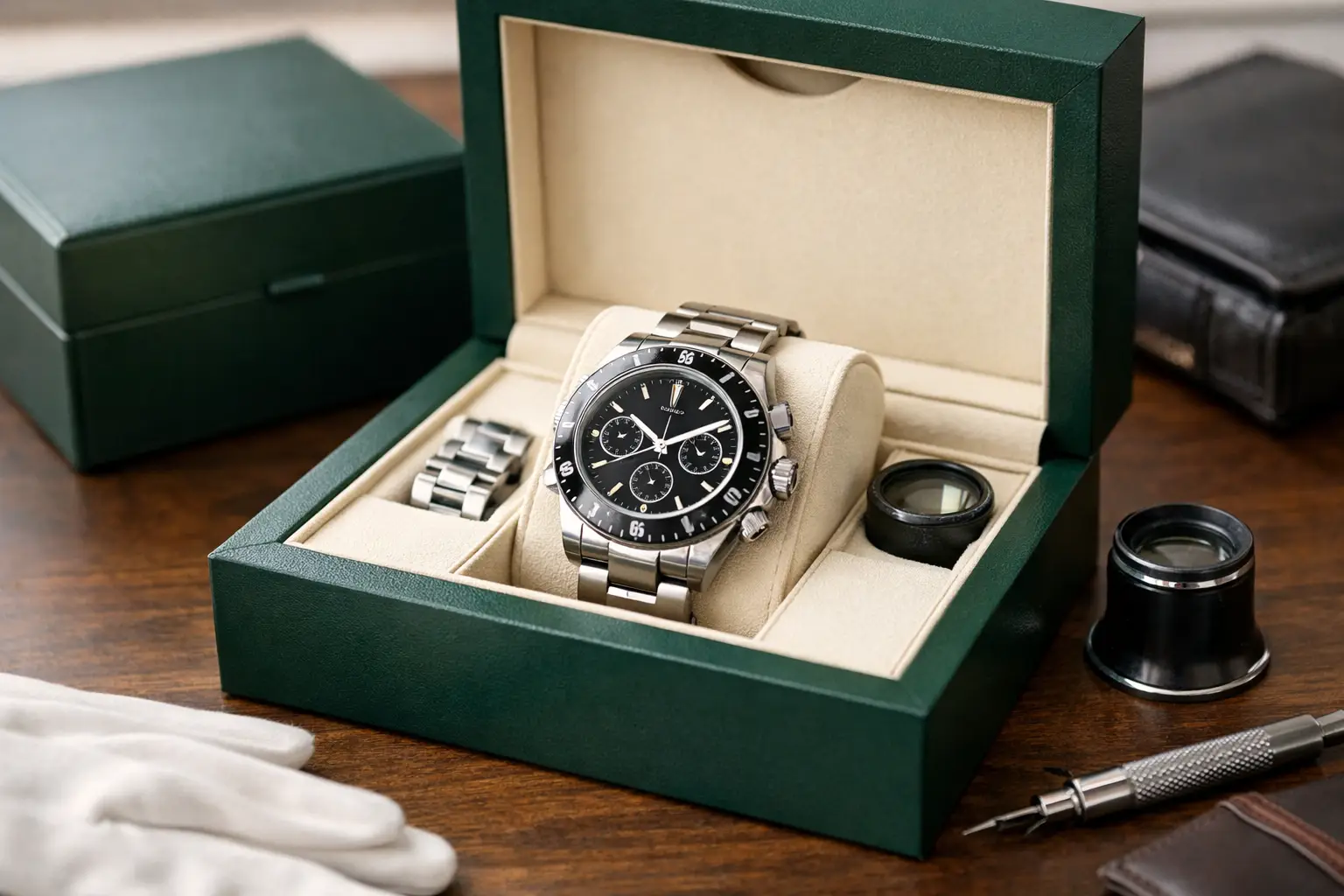
Many buyers place too much confidence in packaging. Original boxes, warranty cards, manuals, tags, and receipts are valuable, but they are not proof by themselves. Counterfeiters now reproduce accessories with impressive accuracy, and some fake watches are sold with convincing sets.
That said, paperwork still matters when viewed as part of a broader verification process. The reference on the card should match the watch. The serial details should make sense for the production period. The seller should be able to explain the watch’s history clearly, including service records if available.
If the paperwork looks perfect but the watch itself raises questions, trust the watch first. Accessories can be copied. Authentic construction is much harder to fake consistently.
The seller is part of the authentication process
When buyers ask how to tell real Rolex watches from fakes, the answer is not limited to the object. The seller matters just as much. A watch offered far below market value with vague photos, incomplete answers, and pressure to move quickly is not a bargain. It is a warning.
A reputable luxury watch seller should stand behind authenticity in plain terms. That means clear inspection standards, transparent condition reporting, warranty support, and a willingness to answer detailed questions. They should also be comfortable discussing whether parts are original, whether the watch has been polished, and whether it has any service history.
This is where many expensive mistakes can be avoided. A counterfeit watch may look convincing online. A serious seller’s process is much harder to imitate. In a market built on reputation, confidence should come from verification, not sales urgency.
Red flags that deserve immediate caution
Some signs are not subtle. Misspelled dial text, incorrect logos, loose bezels, poor date alignment, light overall weight, and low-grade movement noise are common giveaway issues. Price is another one. If a current, high-demand Rolex reference is priced dramatically below prevailing market levels, there is usually a reason.
Photos can also tell you a lot. Be cautious if images are heavily filtered, too low in resolution, or limited to flattering angles. You should be able to see the dial, case sides, clasp, bracelet, serial area where appropriate, and accessories if they are included. If those views are missing, ask why.
It also helps to compare the watch against the exact reference it claims to be. Rolex makes subtle changes across generations, and counterfeiters often mix details from different versions. A bezel style from one era, a dial layout from another, and an incorrect bracelet can expose a fake quickly.
When expert authentication is the only smart move
Some counterfeit Rolex watches are now sophisticated enough that casual inspection is not enough. That is especially true with so-called super fakes, which can imitate weight, finishing, and even certain movement aesthetics. At that level, authentication should include a professional inspection of the movement, case, bracelet, and serial consistency.
For high-value purchases, this is not overcautious. It is standard discipline. The higher the price, the less sense it makes to rely on instinct alone. Trusted dealers, watchmakers, and authentication-backed retailers exist for exactly this reason.
For buyers who want confidence without the uncertainty, a specialist retailer such as Lux-Watch offers a more secure path because the watch is already positioned around authenticity, inspection, condition review, and warranty protection. That is often the difference between shopping and guessing.
A real Rolex should create confidence before and after the sale. If any part of the watch, the paperwork, or the seller leaves you negotiating with doubt, step back. The right piece is worth waiting for, and so is the peace of mind that comes with it.

Comments are closed