


Nautilus vs Royal Oak: Which Holds More Appeal?
One glance is usually enough. In the Nautilus vs Royal Oak conversation, most buyers are not comparing two ordinary luxury sports watches – they are deciding between two of the most recognizable status pieces ever made in steel. Both sit at the top of the market. Both carry real collector gravity. And both can feel very different once they are on the wrist.
For a serious buyer, this is not just a style choice. It is a decision about brand identity, how the watch will wear in daily life, and what kind of statement you want your collection to make. The right answer depends less on hype and more on what matters most to you.
Nautilus vs Royal Oak at a glance
The Patek Philippe Nautilus and Audemars Piguet Royal Oak share an important origin point. Both helped define the luxury sport watch category, and both proved that steel could sit at the highest end of Swiss watchmaking. That said, they project very different personalities.
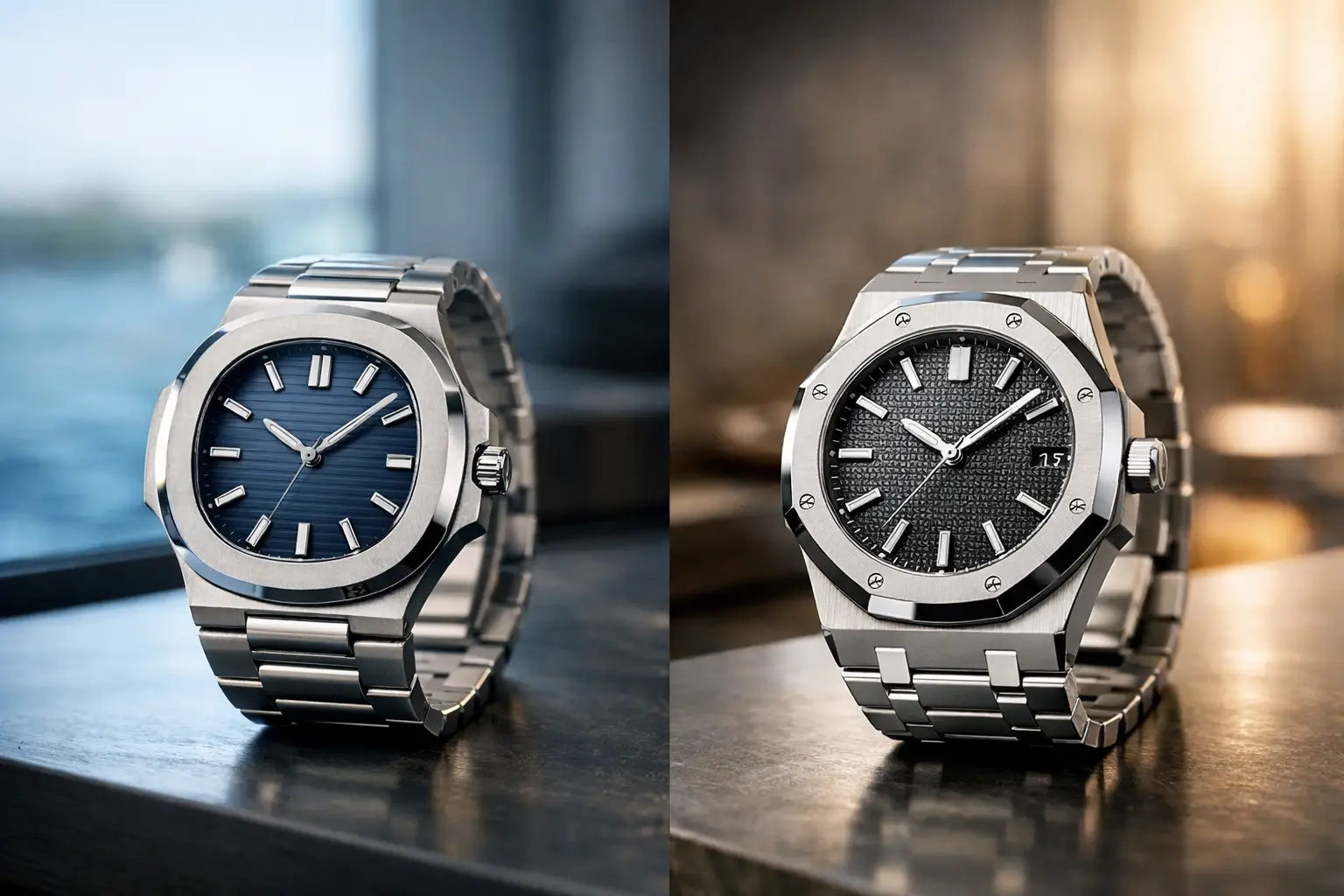
The Nautilus is smoother, more restrained, and more fluid on the wrist. Its rounded octagonal bezel, horizontal dial texture, and integrated bracelet create a softer profile that feels refined without trying too hard. It tends to appeal to buyers who want prestige that reads quietly, even when the watch itself is instantly recognizable.
The Royal Oak is sharper and more architectural. The exposed screws on the bezel, the angular case lines, and the tapisserie dial create more visual tension. It has a bolder presence and often feels more assertive, especially in larger references or Offshore variations. For buyers who want their watch to announce itself with confidence, the Royal Oak often gets there first.
Design language and wrist presence
If your buying decision starts with aesthetics, this is where the split becomes clear.
Why the Nautilus feels more understated
The Nautilus has a cleaner visual rhythm. The case flows into the bracelet with less interruption, and the overall shape feels less industrial than the Royal Oak. Even when you know it is a Patek Philippe, the design tends to whisper rather than shout. That restraint is part of the appeal.
It is also one of the reasons the Nautilus works so well for buyers who want one watch to cover a lot of ground. It can sit under a cuff, pair naturally with tailoring, and still feel at home with casual wear. There is prestige here, but it is delivered with polish.
Why the Royal Oak feels more assertive
The Royal Oak has more edge, literally and visually. The bezel, case finishing, and bracelet links catch light in a more dramatic way. On the wrist, it often feels more like a design object, which is exactly why many collectors want it.
That stronger identity can be a major advantage if you are building a collection around icons. It can also be a drawback if you prefer a more discreet presence. Some buyers admire the Royal Oak for years, then realize the Nautilus suits their lifestyle better because it asks for less attention day to day.
Brand perception and collector psychology
Luxury watch buying is never purely technical. Brand matters, and in this comparison it matters a great deal.
Patek Philippe carries a particular kind of prestige. It is tied to legacy, family ownership, traditional high horology, and a level of social recognition that extends beyond watch enthusiasts. Wearing a Nautilus often signals that you know exactly what you bought and did not need something louder to prove it.
Audemars Piguet has immense credibility, but the feeling is different. The Royal Oak is more design-led and more fashion-visible, especially in modern culture. It has deep collector respect, yet it also carries a more contemporary energy. For some buyers, that makes it more exciting. For others, it makes the Nautilus feel more timeless.
This is where personal intent matters. If you want the watch with the broadest aura of old-world prestige, the Nautilus usually has the edge. If you want a watch with stronger visual identity and a more expressive personality, the Royal Oak is hard to beat.
Wearability and everyday use
In high-value watch buying, comfort should not be treated as a minor detail. A watch in this tier needs to feel right every time you put it on.
Nautilus comfort and versatility
The Nautilus is widely praised for its balance. It tends to wear slim, smooth, and composed. The case shape helps it hug the wrist, and the bracelet usually feels elegant rather than aggressive. For buyers who plan to wear their watch often, this can be a deciding factor.
Its versatility is another strength. If your schedule moves from business meetings to dinners to travel, the Nautilus often adapts without needing to be the center of attention.
Royal Oak fit and presence
The Royal Oak is also highly wearable, but in a different way. Its integrated bracelet can feel fantastic when sized correctly, and its finishing gives it a dynamic quality on the wrist. At the same time, the sharper edges and more angular profile make it feel more deliberate.
That is not a criticism. For many buyers, it is the point. The Royal Oak feels like a choice you made on purpose. Still, if you are sensitive to case geometry or want maximum day-to-night flexibility, the Nautilus may feel easier to live with.
Movement, finishing, and what you are really paying for
No one shopping in this category is only paying for timekeeping. You are paying for finishing, design history, scarcity, and the confidence that comes with owning an authentic example in excellent condition.
Patek Philippe is often seen as the benchmark for refinement, and the Nautilus benefits from that reputation. The finishing is exceptional, the execution is disciplined, and the overall package feels controlled in the way only a top-tier manufacture can deliver.
Audemars Piguet brings a different strength. The Royal Oak’s finishing is among the most distinctive in the industry because the watch relies so heavily on contrast between brushed and polished surfaces. When done right, it is striking. The movement quality is strong, but the emotional impact often comes from the case and bracelet architecture as much as from what is inside.
So which offers more? It depends on what you value. If your eye goes to elegance and traditional prestige, the Nautilus may feel more complete. If you respond to design innovation and visual impact, the Royal Oak may justify itself faster.
Market demand, value, and buying with confidence
The Nautilus and Royal Oak both sit in a part of the market where availability, condition, provenance, and authenticity matter as much as the model name on the dial. This is especially true in the secondary luxury space, where small differences can have major implications for value.
The Nautilus often commands stronger pure prestige pricing, especially in highly sought-after references. The Royal Oak has also shown remarkable demand, with certain configurations attracting fierce interest from collectors who want the original integrated-bracelet icon with a more assertive identity.
Neither is a simple value play. Markets shift, tastes evolve, and specific references can outperform expectations while others level off. That is why serious buyers focus on the full package: correct parts, clean history, strong condition, original box and papers when available, and inspection by a trusted luxury watch specialist. On a purchase at this level, reassurance is not optional.
For many clients, that trust is what turns interest into action. An authenticated watch backed by warranty protection and clear condition standards removes the uncertainty that too often surrounds high-end buying.
Which one should you buy?
If you want discreet authority, broad versatility, and one of the most refined luxury sport watches ever produced, the Nautilus is the stronger fit. It suits the buyer who values restraint, heritage, and a watch that speaks with confidence rather than volume.
If you want sharper design, stronger wrist presence, and a watch with unmistakable visual identity, the Royal Oak stands out. It suits the buyer who wants modern collector credibility and does not mind a more assertive look.
There is also the matter of your current collection. If you already own classic round watches, the Royal Oak may add more contrast. If you want a single high-level piece that can do almost everything well, the Nautilus may make more sense.
At Lux-Watch, this is exactly the kind of decision that deserves careful attention. When the stakes are high, the right watch is not just the one with the stronger reputation. It is the one that feels right on your wrist, aligns with your taste, and comes with the confidence of verified authenticity.
Choose the piece that still makes sense after the excitement settles. That is usually the one you will keep.



Comments are closed