


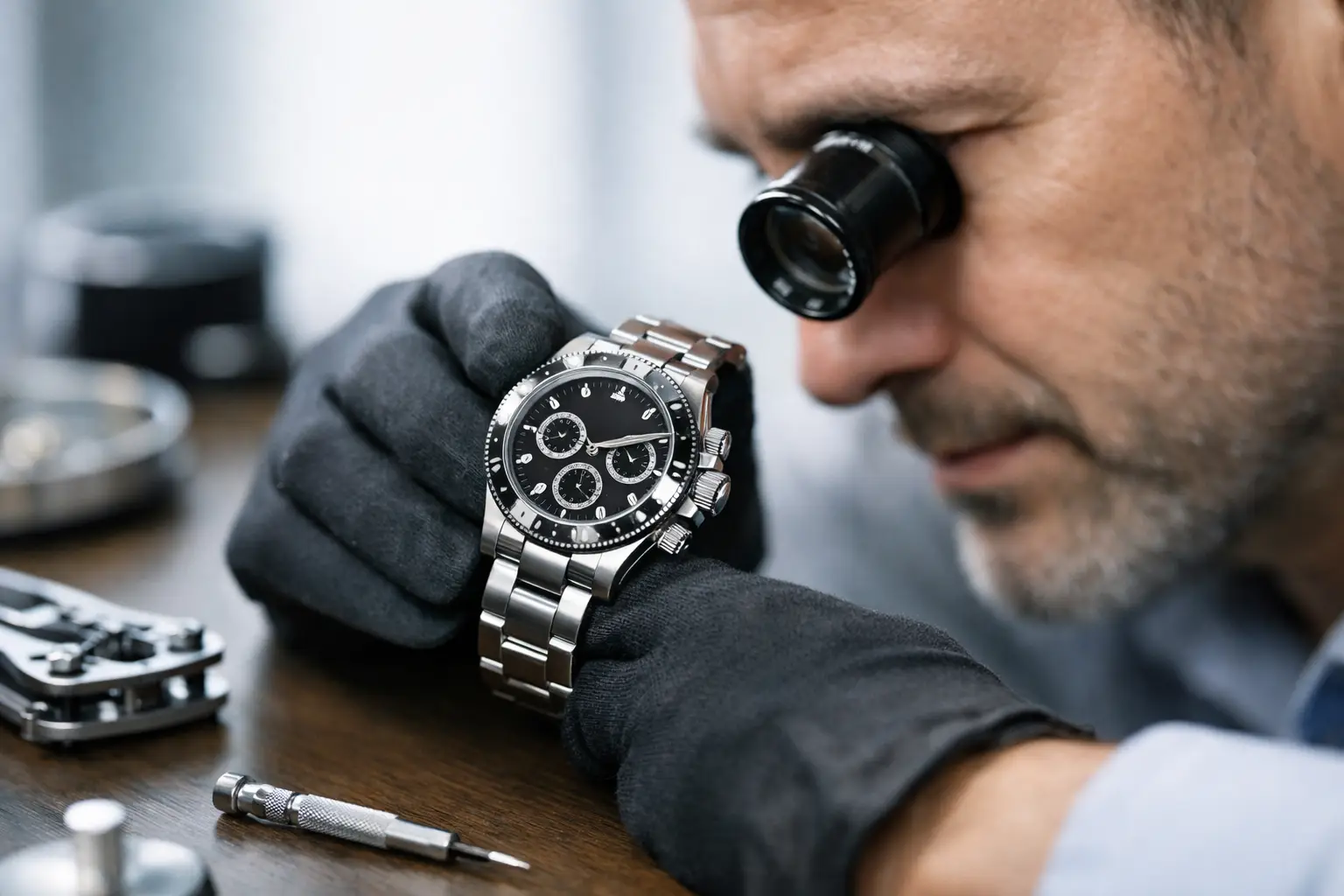
Pre Owned Watch Inspection Example
A luxury watch can look flawless in photos and still raise expensive questions once it is in your hands. That is why a clear pre owned watch inspection example matters. For serious buyers, inspection is not a formality. It is the difference between buying with confidence and inheriting someone else’s problem.
What a pre owned watch inspection example should show
When a retailer says a watch has been inspected, the real question is simple: inspected how? In the high-end secondary market, vague promises are not enough. A proper inspection should document authenticity, mechanical performance, physical condition, and history in a way that reflects the value of the watch.
For a Rolex Submariner, Omega Speedmaster, Cartier Santos, or Patek Philippe Nautilus, the standard should be consistent even if the specifics vary by model. A sport watch with a screw-down crown and water resistance claim needs a different emphasis than a dress watch that will spend most of its life under a cuff. The process should adjust to the watch, but the discipline behind it should not.
A credible inspection example also does something else well. It shows the buyer what was checked before money changed hands. That level of transparency builds trust because it replaces marketing language with observable standards.
A practical pre owned watch inspection example
Imagine a 2021 Omega Speedmaster Moonwatch Professional arriving for intake. The watch includes box and papers, shows light wear on the clasp, and is being prepared for resale. A serious inspection process would begin with identity and authenticity.
1. Model verification and authentication
The reference number, serial number, dial configuration, caseback details, bracelet code, clasp markings, and movement type are checked against known production standards for that model year. The goal is not just confirming that the watch is genuine. It is also confirming that the watch is correct.
That distinction matters. A watch can contain authentic brand parts and still be a problem if it has a service dial from a different era, a replacement bezel inconsistent with the reference, or a bracelet that does not belong to the case. In luxury resale, originality often affects value as much as authenticity.
At this stage, inspectors also review engravings, hallmarks, font quality, finishing consistency, luminous material, hand shape, and movement signatures. If anything does not align with the brand’s standards, the watch should be escalated for deeper review or rejected outright.
2. Condition grading beyond surface appearance
Next comes condition assessment. This is where many buyers make assumptions based on photographs alone. A proper inspection looks past the obvious.
The case is examined for polishing history, edge softness, lug symmetry, dents, and deep scratches. The crystal is checked for chips, internal marks, and replacement signs. The bezel is inspected for alignment, wear, and functionality. The bracelet and clasp are reviewed for stretch, over-polishing, refinishing quality, and mechanical security.
For the Speedmaster example, the inspector might note light superficial wear on the clasp and bracelet, a clean sapphire crystal, strong case lines, and no visible corrosion or impact damage. That is far more useful than calling the watch simply excellent.
3. Movement performance and timing
A luxury watch does not earn confidence on looks alone. The movement has to perform.
The watch is tested on timing equipment to measure rate, amplitude, and beat error in multiple positions. The inspector checks winding feel, chronograph start-stop-reset operation, power reserve behavior, and general movement stability. On an automatic watch, rotor sound and winding efficiency also matter. On a manual-wind watch like the Speedmaster, the crown action and power delivery should feel smooth and deliberate.
Here is what a useful result might look like in plain language: rate within acceptable tolerance, healthy amplitude, low beat error, chronograph functions operating correctly, and power reserve consistent with expected performance. If numbers are outside the acceptable range, the watch should be serviced or disclosed appropriately. There is no luxury in avoidable uncertainty.
4. Water resistance and case integrity
For any watch sold with water resistance expectations, pressure testing is part of a responsible inspection. This does not mean every pre-owned watch should be treated like a dive-ready tool watch. It does mean any claim about water resistance should be backed by testing, not assumption.
The inspector evaluates gasket condition, crown function, pusher integrity where applicable, and caseback seal. Then the watch is pressure tested according to the practical limits appropriate for the model and its age. A modern dive watch and a vintage dress watch should not be handled the same way.
In our example, if the Speedmaster passes the relevant dry pressure test and shows sound case integrity, that result should be recorded. If it does not, the watch can still be sold, but the limitation should be explicit. Buyers should never have to guess whether a watch can safely handle everyday exposure.
5. History and provenance review
A clean history is part of condition. Inspection should include a review of accompanying papers, service records when available, and checks against theft or loss databases where commercially appropriate. The seller’s source and acquisition path also matter.
This is especially important for high-value pieces from Rolex, Audemars Piguet, Richard Mille, and Patek Philippe, where market prices attract both counterfeit activity and paperwork manipulation. Box and papers are helpful, but they are not proof on their own. They support the watch. They do not replace expert verification.
If the example watch includes original warranty cards and matching serial information, that strengthens buyer confidence. If it is a watch-only piece with no accessories, the inspection standard should become even stricter.
What buyers should expect in the final inspection record
The best inspection records are clear, not theatrical. They do not need pages of technical jargon to be credible. They need to answer the buyer’s real concerns.
A useful final report should identify the watch by brand, model, reference, and serial details where appropriate. It should state whether authenticity was confirmed, summarize the cosmetic condition honestly, note timing and functional performance, record water resistance results if relevant, and disclose any replaced parts, service history, or limitations.
For example, a final note might read like this: Authentic Omega Speedmaster Moonwatch Professional, reference confirmed. Case and bracelet show light wear consistent with careful ownership. Crystal clean. Chronograph functions correct. Movement tested and performing within acceptable range. Pressure test passed at applicable standard. Original box and papers included. No adverse history identified.
That style of reporting does not oversell the watch. It respects the buyer.
Where inspection standards often fall short
Not every pre-owned watch seller works at the same level. Some rely heavily on visual checks and broad condition labels. Others confirm authenticity but spend too little time on movement performance or pressure testing. Some sellers avoid discussing refinishing or replacement parts because those details may reduce appeal.
This is where buyers should be careful. A polished case is not always a dealbreaker. A replacement crystal is not always a negative. A service hand set may even improve functionality. What matters is disclosure and how those changes affect collectibility, value, and your intended use.
A buyer pursuing an investment-grade Royal Oak will care deeply about original finishing and component correctness. A buyer shopping for a daily-wear Breitling may prioritize performance, warranty backing, and cosmetic freshness. Inspection should reflect those priorities honestly instead of pretending every watch is being judged by the same collector standard.
Why this matters more with luxury watches
The higher the price point, the smaller the margin for ambiguity. A luxury watch is not just an accessory purchase. It is often a five-figure transaction involving brand heritage, long-term value, and personal trust.
That is why credible retailers build their reputation on inspection discipline, not just inventory. When a watch has been checked for authenticity, accuracy, water resistance, condition, and clean history, the buying experience changes. It feels less like a gamble and more like a well-supported acquisition.
At Lux-Watch, that trust-first standard is what serious buyers should expect from the secondary luxury market. Prestige means very little without verification behind it.
If you are evaluating your next purchase, ask to see the substance behind the promise. A strong inspection example will tell you a great deal about the watch, but it also tells you just as much about the seller.



Comments are closed