



Rolex Authentication Case Study for Serious Buyers
A Rolex authentication case study is most useful when the watch looks convincing at first glance. The difficult counterfeits do. They can arrive with a familiar green box, a correct-looking serial range, a substantial bracelet, and a dial that appears credible across a showroom counter. For a buyer spending five figures, that surface-level confidence is not enough.
This representative case follows the inspection of a pre-owned Rolex Submariner offered with its bracelet, presentation set, and seller-provided paperwork. The objective was not merely to determine whether the watch was genuine. It was to establish whether its major components were correct for the reference, whether its condition matched the asking price, and whether its history supported a confident purchase.
The Case: A Pre-Owned Rolex Submariner
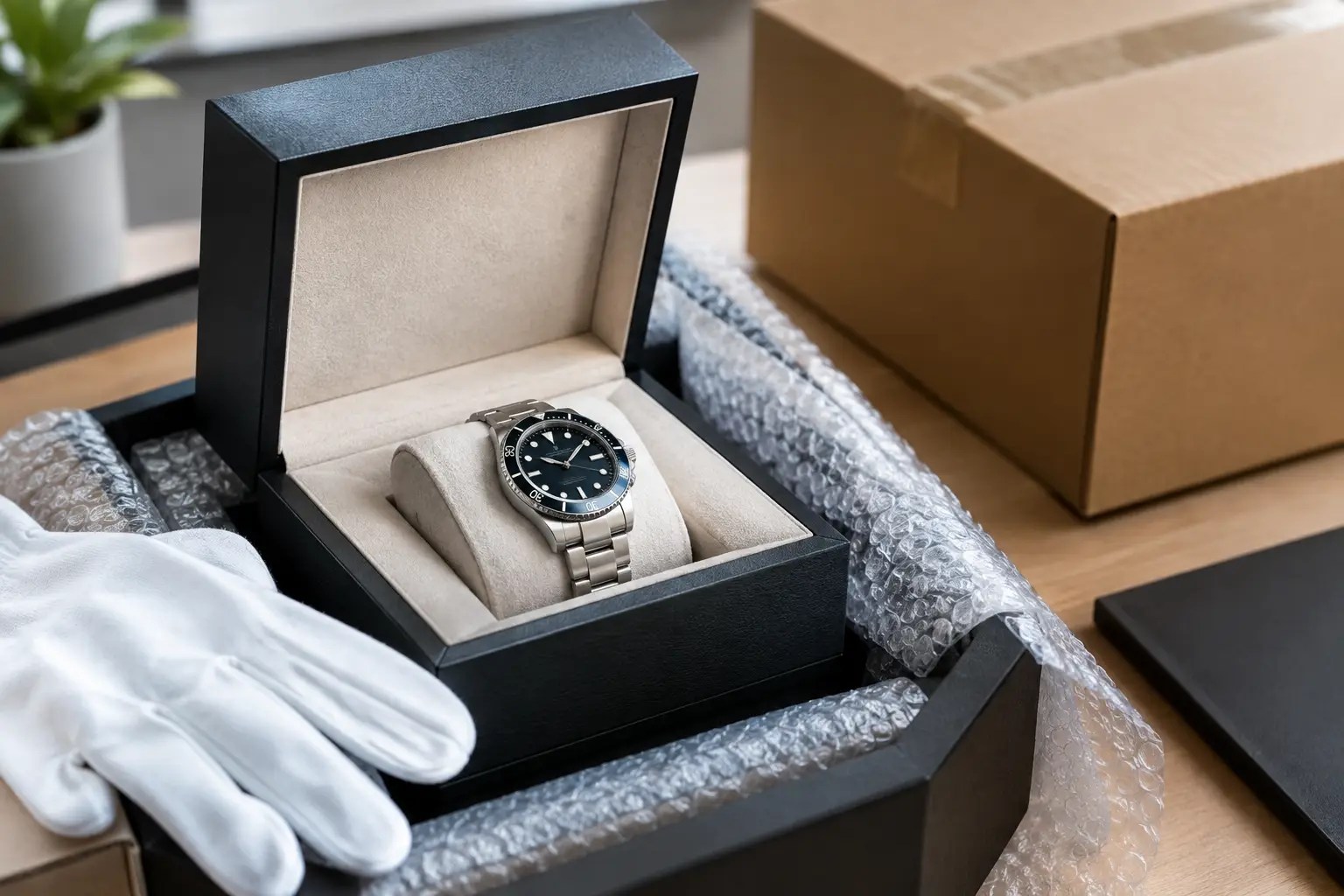
The watch presented as a modern stainless steel Rolex Submariner Date with a black dial and black ceramic bezel. Its overall condition was attractive: crisp case lines, a clean crystal, a tight bracelet, and no obvious signs of neglect. The seller also supplied a warranty card and box.
That is a promising starting point, but it is not an authentication result. Luxury watch authentication works by building a consistent story from many separate details. If the reference, production period, dial configuration, bracelet code, movement architecture, engraving, and supplied documents all agree, confidence rises. If one or more elements conflict, the watch requires closer scrutiny.
The first task was to identify the exact reference and approximate production period from the watch itself, rather than relying on the seller’s description. This distinction matters because Rolex has made subtle but meaningful changes across generations. A component may be authentic Rolex and still be incorrect for the watch it is attached to.
Rolex Authentication Case Study: The Inspection Process
Reference, case, and external details
The case was examined under magnification before the bracelet or caseback was removed. The engraving between the lugs, rehaut engraving, bezel construction, crown action, crystal height, and dial printing were evaluated as a group.
On a genuine modern Submariner, the finishing should feel deliberate rather than decorative. The transitions between brushed and polished surfaces are clean. The crown screws down smoothly. The bezel clicks with controlled, even resistance. The ceramic insert, numerals, and pip should sit correctly within the bezel assembly. None of these checks alone proves authenticity, but poor execution often exposes a counterfeit quickly.
The dial required equal attention. Hour markers were inspected for shape, alignment, luminous material, and consistency. The coronet, text spacing, minute track, date window, and Cyclops magnification were compared against the expected configuration for the reference. Counterfeit dials can be exceptionally close, yet small irregularities in printing, marker placement, or date presentation frequently become apparent under proper inspection.
In this case, the dial, bezel, crystal, case profile, and engraved details aligned with the stated reference. The watch passed the visual stage. It had not yet passed authentication.
Bracelet and clasp consistency
A Rolex bracelet is a highly informative component, particularly on popular sport models. It should be examined for its correct end links, clasp construction, code markings, adjustment system, finishing pattern, and degree of stretch.
The bracelet on this Submariner matched the expected Oyster configuration. The clasp operated firmly, the extension system engaged correctly, and the finishing aligned with the case. Minor wear was present along the clasp and outer links, but it was consistent with careful use rather than heavy polishing or replacement parts.
This is where condition and originality can pull in different directions. A heavily refinished bracelet may look brighter in listing photos, but softened edges can reduce collector appeal. Conversely, an unpolished watch may retain stronger geometry while showing more honest wear. The better choice depends on the buyer: a collector may prioritize originality, while a gift buyer may reasonably prefer a cleaner presentation.
Movement inspection: the decisive internal check
The caseback was opened by a qualified watch professional using appropriate equipment. The movement was then inspected for correct caliber architecture, bridge layout, engravings, finishing, rotor behavior, and signs of unauthorized parts or poor service work.
For this case, the movement corresponded to the correct Rolex caliber family for the identified Submariner reference. The rotor winding action was smooth, the components showed no signs of corrosion, and the internal construction was consistent with genuine Rolex manufacture.
A movement check is among the strongest safeguards available, but even this step requires judgment. A genuine movement does not automatically mean every external part is original. A watch may contain an authentic movement paired with a replacement dial, aftermarket bezel, or incorrect bracelet. That is why full authentication is never a single-test exercise.
Timing, water resistance, and functional condition
Authenticity and performance are related but separate questions. A genuine Rolex can still require service. After the movement assessment, the watch was tested for timekeeping, amplitude, beat error, winding performance, date change, and water resistance.
The Submariner showed stable timekeeping within an acceptable range for a pre-owned luxury sports watch. Its date advanced correctly, and the winding and setting functions worked as expected. A water-resistance test also supported the integrity of the case seals at the time of inspection.
Water resistance deserves a measured expectation. Passing a pressure test confirms performance at that moment, not permanent immunity from moisture. Gaskets age, crowns can be damaged, and service intervals matter. A buyer who plans to swim regularly should maintain the watch accordingly rather than assume that a dive-watch label removes all risk.
Documents Help, but They Do Not Authenticate the Watch
The supplied warranty card was reviewed for reference accuracy, serial consistency, print quality, and alignment with the watch’s estimated production period. The presentation box and accompanying materials were also assessed for appropriate design and condition.
The card appeared consistent with the watch, and the reference and serial information matched. That strengthened the file, but documentation was treated as supporting evidence rather than final proof. Boxes, cards, booklets, and tags can be separated from a watch, replaced, or counterfeited. The watch itself must remain the center of the authentication process.
For high-value Rolex purchases, clean history is also part of the decision. Buyers should expect a clear description of condition, known service work, included accessories, and any replaced components. A transparent seller does not hide behind vague phrases such as “appears original” when a specific answer is available.
The Result: Authentic, Correct, and Priced on Condition
The inspection concluded that the Submariner was authentic, correctly configured for its reference, and functioning properly at the time of examination. The bracelet, dial, bezel, and movement were consistent with the watch. The accompanying card supported its provenance, while the condition report documented normal signs of careful ownership.
The final valuation was not based on authenticity alone. It reflected the complete package: reference desirability, condition, bracelet wear, included documentation, performance, and current market demand. This is the difference between buying a real Rolex and buying the right Rolex at the right price.
At Lux-Watch, that distinction guides the standard for prestige timepieces. Buyers deserve more than an assurance printed beside a product listing. They deserve a watch assessed for authenticity, condition, accuracy, water resistance, and a history that can be explained clearly.
What This Means for a Rolex Buyer
A convincing appearance, a box, and a serial number should never be the end of the conversation. Ask whether the reference has been verified, whether the movement has been inspected, whether the bracelet and dial are correct, and whether the watch has been tested for performance. If a seller cannot answer directly, the uncertainty belongs in the price – or in the decision to walk away.
The best Rolex purchase feels exciting before it arrives and reassuring long after it is on the wrist. That confidence comes from disciplined authentication, clear condition reporting, and a seller willing to stand behind every detail.


Comments are closed