


Luxury Watch Authentication Process Example
A luxury watch can look flawless in photos and still fail the tests that matter. That is why a luxury watch authentication process example is useful for serious buyers – not as marketing language, but as a clear view of how a high-value timepiece is verified before it is offered with confidence.
In the secondary market, authenticity is only one part of the decision. Buyers also want to know whether the watch is correctly assembled, whether replacement parts affect value, whether performance matches the brand standard, and whether the watch carries any hidden risk. A proper authentication process addresses all of that.
A real luxury watch authentication process example
The strongest authentication workflows do not rely on a single checkpoint. They combine document review, physical inspection, mechanical testing, and history screening. If one area raises concern, the watch does not move forward until the issue is resolved.
Imagine a stainless steel Rolex Submariner arriving from a private seller. It comes with a box, a warranty card, and appears visually correct at first glance. For an experienced luxury watch retailer, that is only the starting point.
Step 1: Intake and identity check
The process begins with the basic identity of the watch. The reference number, serial number, case size, metal type, dial configuration, bracelet style, clasp code, and overall presentation are reviewed against what that model should be.
This matters because many counterfeit watches now copy the broad look of genuine pieces very well. The obvious fakes are easy to catch. The harder cases involve watches that use convincing exterior parts, mismatched components from different references, or altered serials. A watch can be partly genuine and still not be correct.
At this stage, the packaging and accessories are reviewed, but they are never treated as final proof. Boxes, booklets, tags, and cards can be lost, replaced, or counterfeited. They support the file. They do not determine authenticity on their own.
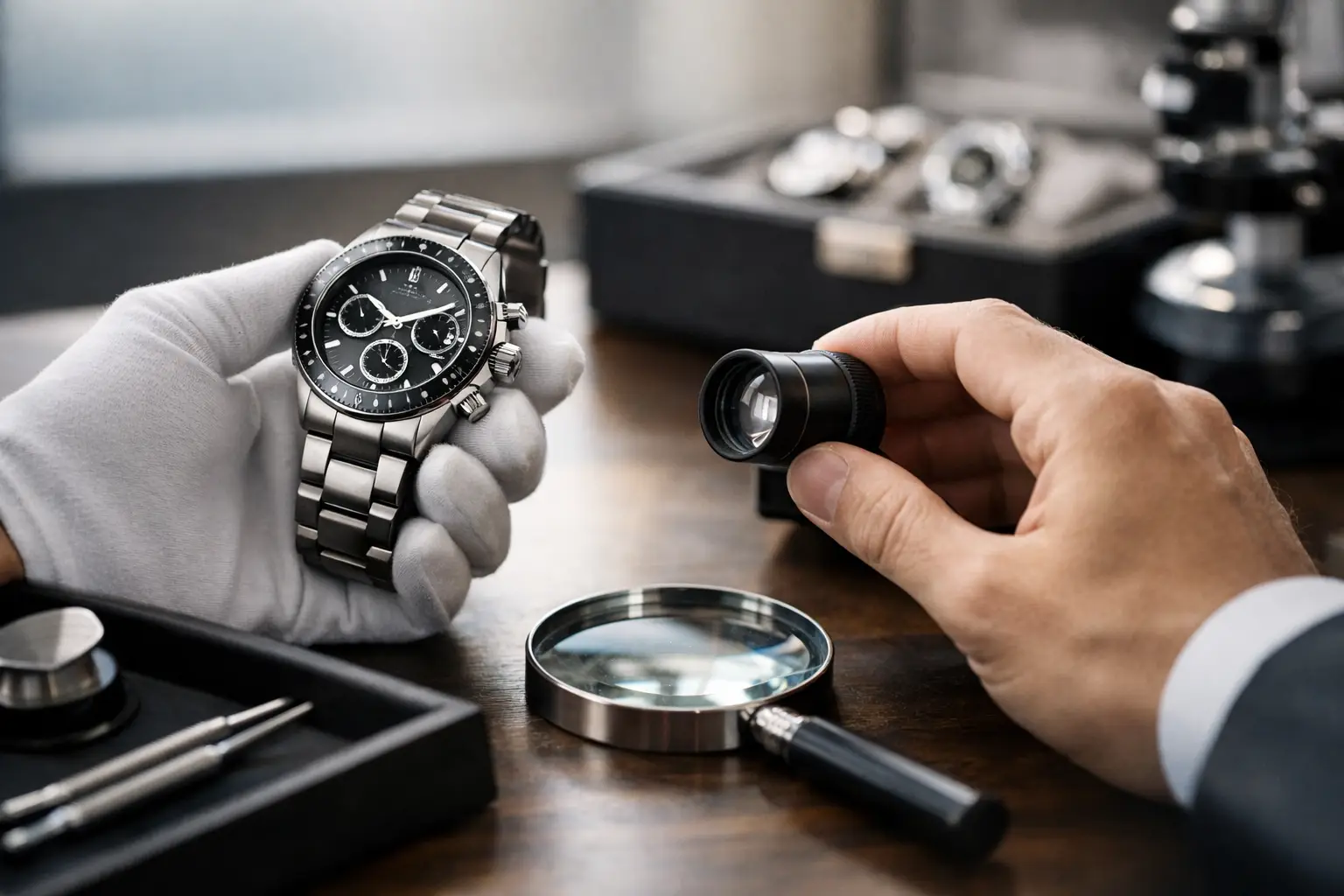
Step 2: Exterior examination under magnification
Next comes a close physical inspection. The case finishing, bezel engravings, crown shape, dial printing, hand set, lume application, crystal, rehaut details, bracelet construction, and clasp mechanics are checked under magnification.
Luxury brands manufacture with extraordinary consistency. That precision becomes one of the clearest ways to spot trouble. Uneven font weight on a dial, incorrect spacing in an engraving, poor edge finishing, or a bracelet that feels slightly off can all point to a problem.
At the same time, a reputable authentication team distinguishes between damage and deception. A polished case, aftermarket crystal, or service replacement crown does not automatically mean the watch is fake. It may, however, change value, collectibility, and how the watch should be represented to the buyer.
Step 3: Movement verification
For many watches, the movement tells the truth faster than the exterior. The case is opened and the caliber is examined for correct architecture, finishing, engravings, rotor design, balance layout, and service condition.
This is where experience matters. A watch may have a genuine case and dial but contain an incorrect movement. In other cases, the movement is authentic but from a different model family or production period. Those details matter in luxury watch transactions because originality affects both confidence and price.
With brands such as Omega, Breitling, Cartier, and Panerai, movement verification can also reveal whether a watch has been heavily modified, poorly repaired, or assembled from mixed parts. A watch that is technically genuine but no longer correct should never be presented as if it were untouched.
Why the luxury watch authentication process example goes beyond authenticity
Affluent buyers are rarely concerned only with whether a watch is real. They are also asking a more practical question: is this the right watch to buy at this price, in this condition, with this ownership profile?
That is why a complete authentication workflow extends into performance and background checks.
Step 4: Timekeeping and accuracy testing
Once identity and movement are confirmed, the watch is tested for performance. Timegrapher results help assess rate, amplitude, and beat error. These readings show whether the movement is running within acceptable expectations for its age, model, and service status.
A luxury watch does not need to be brand-new to be a strong purchase. A pre-owned Patek Philippe Nautilus or Audemars Piguet Royal Oak Offshore may show honest wear and still be an excellent acquisition. But if the movement shows signs of neglect, unstable performance, or a need for immediate service, that should be addressed before sale or clearly reflected in how the watch is presented.
Step 5: Water resistance and functional checks
Water resistance testing is another important step, especially for sport models such as the Rolex Submariner, Omega Seamaster, or Panerai Luminor. A watch may look pristine and still fail pressure testing because of degraded gaskets, caseback issues, or crown tube wear.
Beyond water resistance, the full set of functions should be reviewed. That includes date change, chronograph operation, bezel action, power reserve behavior, crown threading, and clasp security. These are not minor details when the watch is expected to deliver daily reliability along with prestige.
Step 6: Condition grading and originality review
Condition is where trust can either be reinforced or damaged. A serious seller does not flatten every watch into the same broad description. The case edges, bracelet stretch, crystal condition, dial integrity, lume aging, and signs of polishing all affect desirability.
Originality also sits here. A service dial may be legitimate, but some collectors prefer original tritium dials. A replacement bezel insert may improve appearance, yet reduce appeal for a buyer seeking period correctness. This is where authentication becomes more nuanced than a simple real-or-fake decision.
For that reason, the best luxury retailers pair authentication with transparent representation. The watch must be genuine, but it also must be honestly described.
Clean-history verification matters more than many buyers realize
A watch can pass visual and mechanical inspection and still raise legal or transactional concerns. Clean-history screening helps identify whether a timepiece has been reported stolen, carries suspicious provenance, or presents ownership inconsistencies.
This is especially important in the high-end market, where values can move well into five or six figures. Buyers of a Richard Mille, Patek Philippe, or limited-edition Audemars Piguet are not simply purchasing an accessory. They are acquiring a significant asset, and asset-level diligence should follow.
There are limits here, and honesty matters. Not every older luxury watch comes with a complete paper trail. Vintage and even modern pieces can circulate without full original documentation. That does not make them problematic by default. It means the seller should apply stronger scrutiny in the areas that can be verified and disclose what is and is not available.
What a buyer should take from this process
If you are evaluating a seller, ask whether their authentication process includes movement inspection, performance testing, water resistance checks, and clean-history review. If the answer stays vague or focuses only on visual inspection, that is not enough for a serious purchase.
You should also listen for nuance. Trustworthy retailers do not pretend every pre-owned watch is identical in condition or originality. They explain what is verified, what has been tested, what accessories are included, and whether any service or replacement components are present.
That approach is especially valuable for buyers entering the market for the first time. An experienced collector may already know how to compare reference details or read a timegrapher report. A gift buyer or first-time purchaser often does not. What they need is a seller whose process replaces uncertainty with clear standards.
At Lux-Watch, that trust-first standard is what turns online luxury buying from a risk into a confident decision. When a watch is inspected for authenticity, accuracy, water resistance, condition, and clean history, the transaction feels as it should – secure, premium, and worthy of the piece itself.
A fine watch should never ask you to take authenticity on faith. The right process gives you something better: proof, precision, and the confidence to buy well.



Comments are closed