


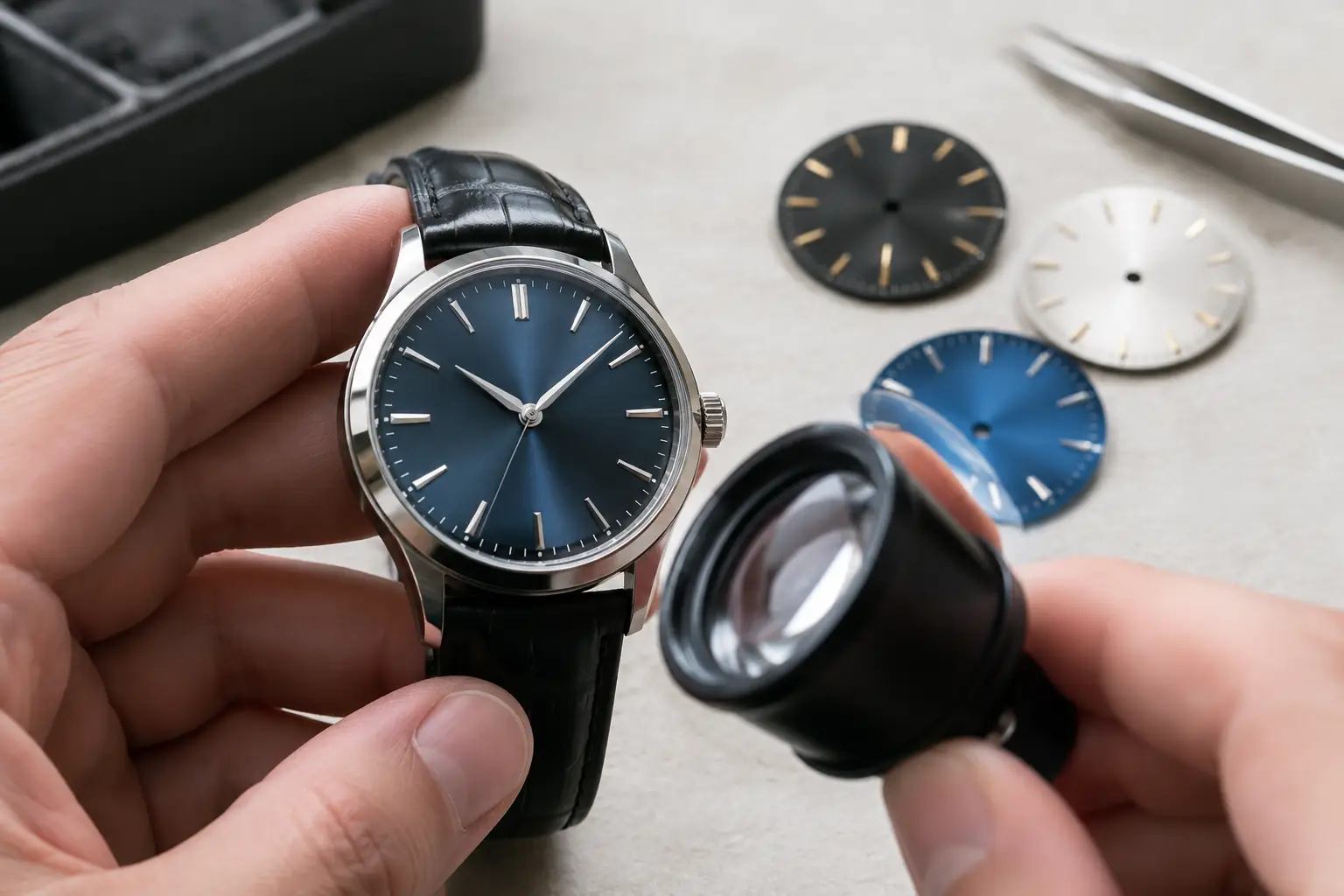
Spotting Refinished Watch Dials Before You Buy
A dial can account for a remarkable share of a vintage watch’s appeal and market value. That is why spotting refinished watch dials matters before committing to a purchase, especially when evaluating collectible Rolex, Omega, Cartier, Patek Philippe, or Breitling references. A refinished dial is not automatically deceptive or unacceptable. But it must be disclosed accurately, priced accordingly, and assessed in the context of the watch’s age, originality, and intended use.
For a collector seeking historical integrity, an undisclosed redial can turn a promising acquisition into an expensive disappointment. For a buyer who simply wants a beautiful, wearable vintage piece, a professional restoration may be perfectly reasonable. The difference is confidence: knowing precisely what you are buying.
What Is a Refinished Watch Dial?
A refinished dial, often called a redial, is a dial that has been repainted, reprinted, relumed, or otherwise restored after leaving the manufacturer. The work may range from a careful attempt to recreate the original appearance to a complete redesign using incorrect fonts, colors, markers, or branding.
Dials are restored for understandable reasons. Moisture damage, sun fading, corrosion, smoke exposure, and careless cleaning can leave an original dial unattractive or difficult to read. A watchmaker or dial-restoration specialist may repaint it to improve its appearance. The concern begins when the seller presents that restored surface as original.
In the luxury watch market, originality often carries a premium because it preserves the object’s history. A naturally aged tropical dial, an even cream-colored lume plot, or period-correct printing may be more desirable than a dial that appears newly made. Yet pristine condition alone is not proof of originality. In fact, perfection on a decades-old watch can be a reason to look closer.
The First Signs of a Refinished Watch Dial
The most revealing details are often visible before the watch ever reaches a workbench. Start with high-resolution, straight-on images. A seller should be able to provide clear photographs of the full dial, not only stylized wrist shots or heavily edited images.
Printing That Looks Too Heavy or Too Soft
Original dial printing is usually sharp, consistent, and appropriate to the era. On a refinished dial, lettering can appear unusually bold, thick, fuzzy, or uneven. Compare the shape of individual letters, the spacing between words, and the placement of minute-track marks against known correct examples of the same reference and production period.
Pay close attention to brand signatures, model names, depth ratings, and small text near six o’clock. A printing error can be subtle: the tail of an “R” may be wrong, a “Swiss Made” line may sit too high, or the spacing in “Oyster Perpetual” may look compressed. On certain collectible references, these details are decisive.
Do not rely on a single online image as a benchmark. Dials changed throughout production runs, and camera angles can distort proportions. Look for multiple examples from respected auction archives, reference books, and established specialists.
An Unnatural Surface or Incorrect Finish
Luxury watch dials were produced in a wide range of finishes: matte, glossy, lacquered, sunburst, grained, brushed, galvanic, and textured. A refinished dial may have the wrong sheen for its reference. A matte dial can look overly glossy, while a once-glossy dial may have a flat, painted appearance.
Inspect the surface around applied markers, subdials, date windows, and dial edges. Repainting can leave pooling, uneven texture, tiny dust inclusions, or paint buildup where the original finish should be crisp. On a chronograph, subdial rings and printed scales are particularly useful because their geometry exposes inconsistent restoration work.
Color is another useful clue. A dial that should be warm silver may be bright white. A blue dial may appear too saturated. A vintage black dial can look unusually fresh and uniform when every other component shows decades of wear. Condition should make sense across the entire watch.
Lume That Does Not Match Its Age
Luminous material offers valuable evidence, though it requires nuance. Original tritium lume often ages to cream, yellow, tan, or dark brown, but its appearance varies with storage conditions and climate. A matching set of bright white plots and hands on a 1960s watch may indicate reluming, replacement hands, or restoration. It may also be legitimate service work.
Look for lume that spills beyond marker boundaries, sits unevenly in plots, or has a texture that looks too smooth and new. Check whether the hands and dial plots age consistently. A mismatch is not proof of wrongdoing, but it deserves a clear explanation.
Under ultraviolet light, vintage tritium typically reacts briefly and then fades, while modern luminous material often glows more strongly and longer. This is a supporting test, not a verdict. Some original dials have been cleaned, some old lume behaves differently, and UV exposure should be performed carefully by an experienced professional.
Compare the Dial to the Entire Watch
A dial never exists in isolation. Its condition should align with the case, bezel, hands, movement, bracelet, and documented service history. A heavily polished case with a flawless dial may point to a watch that has undergone broad restoration. That does not necessarily make it a poor purchase, but it changes the conversation about originality and price.
The reference and serial range matter as well. Manufacturers made running changes that can affect logo position, dial wording, handset style, and lume configuration. A dial that is correct for one year may be wrong for another. This is especially relevant with Rolex sports references, Omega Speedmasters, and vintage Cartier models, where small variations have meaningful collector implications.
Examine the dial feet when possible. These small posts secure the dial to the movement, and their position must correspond to the correct caliber. A dial with altered, removed, or poorly repaired feet can signal that it was adapted from another reference. This inspection normally requires opening the watch, so it is best handled by a qualified watchmaker during authentication.
Ask the Questions That Protect Your Purchase
A credible seller should be direct when asked about dial originality. Ask whether the dial has been refinished, repainted, relumed, cleaned, or replaced. If any work was performed, ask who completed it, when it was completed, and whether supporting service documentation is available.
Request unedited macro photographs in natural light, along with images of the movement, caseback, serial or reference markings where appropriate, and any original packaging or paperwork. Documentation does not guarantee an untouched dial, but it strengthens the overall provenance picture.
Be equally clear about your own priorities. If you are purchasing a rare vintage reference as a long-term collector piece, originality should be a central part of the evaluation. If you want an elegant vintage watch to wear regularly, a high-quality, honestly disclosed restoration may offer excellent value. The right choice depends on the watch, the quality of the work, and the transparency of the transaction.
Price Should Reflect Originality
An undisclosed refinished dial is a red flag. A disclosed refinished dial is a condition factor that should be reflected in the price. The discount can vary widely. On a common vintage watch, the impact may be modest if the restoration is attractive and professionally done. On a rare or highly collectible reference, the loss in value can be substantial because the original dial is often the defining component.
Be cautious with descriptions such as “restored to original specification” or “professionally refinished.” Those phrases may be accurate, but they do not mean the dial is factory original. Ask for specifics rather than assuming. Likewise, terms such as “aged patina” should be examined carefully, as artificial aging is possible.
At Lux-Watch, authenticity and condition are evaluated with the seriousness high-value purchases require. A trustworthy transaction should make the watch’s condition understandable, not leave buyers to decode vague language after the sale.
When Expert Review Is Worth It
For an expensive vintage watch, independent review is often the most cost-effective protection available. A qualified vintage specialist can inspect dial printing under magnification, assess lume, verify movement and dial compatibility, and compare the piece with known production characteristics. This is particularly worthwhile when a rare dial variation is being used to justify a significant premium.
Even experts can disagree on difficult vintage pieces. Factory service dials, transitional production periods, and watches with incomplete histories can leave room for interpretation. What matters is that uncertainty is acknowledged and priced fairly, rather than concealed behind certainty that the evidence cannot support.
A beautiful watch should not become less appealing simply because it has been restored. It should, however, be bought with open eyes. Ask for the details, compare the evidence, and choose the level of originality that matches both your collecting goals and the confidence you expect from a luxury purchase.


Comments are closed