


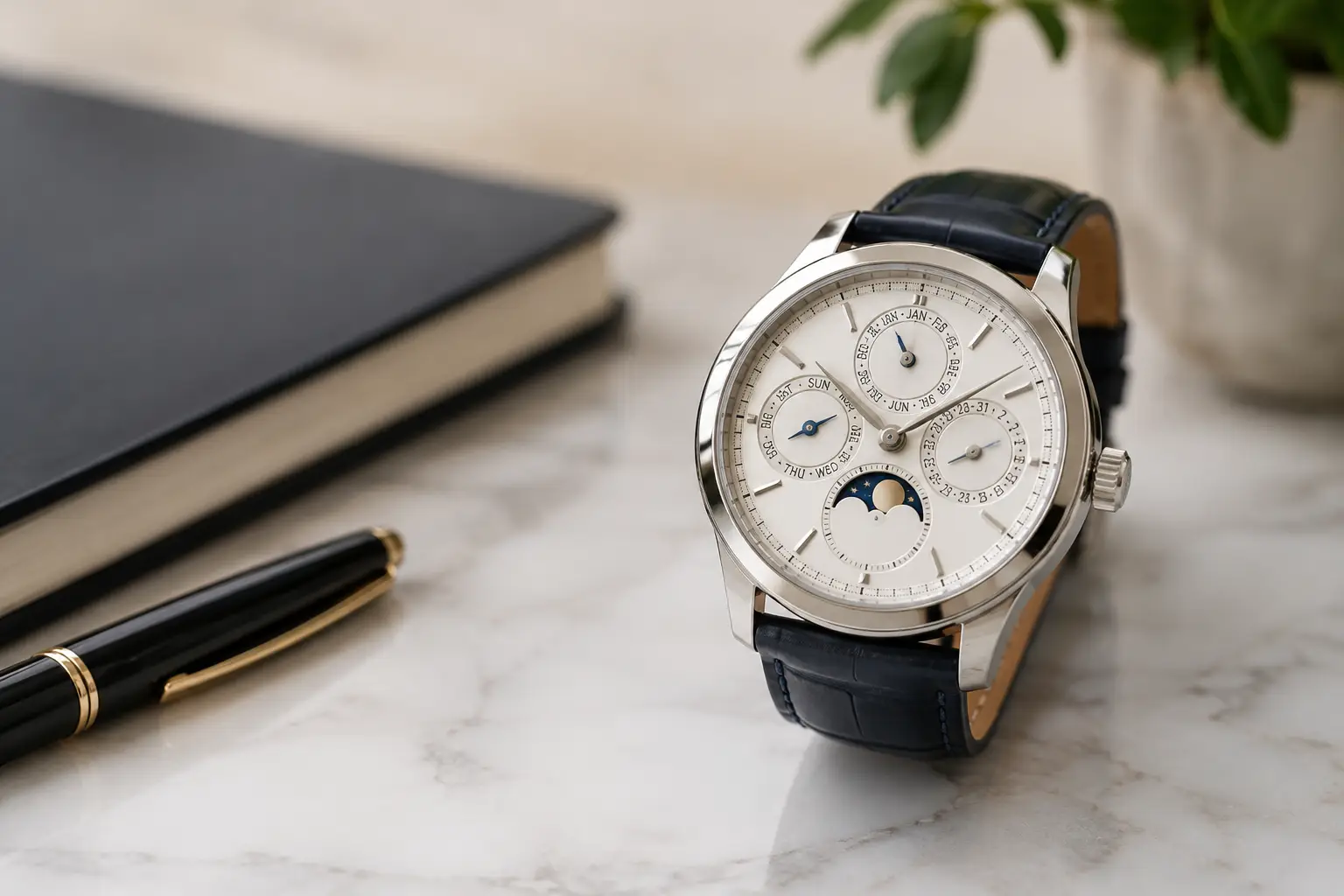
Understanding Perpetual Calendar Watches
A perpetual calendar is one of the clearest signs that a watch is more than a status piece. Understanding perpetual calendar watches means appreciating a mechanism designed to recognize the uneven rhythm of the Gregorian calendar: 30-day months, 31-day months, February, and leap years. It is a complication built for collectors who value mechanical intelligence as much as a distinguished dial.
Unlike a simple date watch, a properly set perpetual calendar can display the correct date for years without manual monthly correction. That accomplishment demands exceptional engineering, precise finishing, and careful ownership. It also explains why these watches sit near the top of the luxury market.
What Is a Perpetual Calendar Watch?
A perpetual calendar watch is a mechanical timepiece that automatically tracks the date, day, month, and usually the leap-year cycle. Its movement is programmed through a series of cams, gears, levers, and springs that determine how many days each month contains.
Most date watches advance from the 31st directly to the 1st, so they require adjustment after shorter months. An annual calendar improves on that arrangement by accounting for 30-day and 31-day months, but it still needs one correction at the end of February. A perpetual calendar goes further, recognizing February’s 28 days and adding the 29th day in leap years.
The distinction matters because it reflects a different level of watchmaking. A perpetual calendar does not simply display more information. It solves a demanding mechanical problem within a case that may be no thicker than a classic dress watch.
Understanding Perpetual Calendar Watches and Leap Years
The leap-year display is the defining feature. Depending on the model, it may appear through a small aperture, a subdial, or an indicator integrated into the month display. When the watch remains running and correctly set, the mechanism follows the four-year leap-year cycle automatically.
There is one technical exception worth knowing. The Gregorian calendar omits leap years in century years that are not divisible by 400. That means 2100 will not be a leap year. Most traditional perpetual calendar watches will require correction then, though that is hardly a practical concern for a current owner. The exception is a reminder of how closely these watches attempt to mirror a human-made calendar system.
Some high-complication pieces add a moonphase display, chronograph, or split-seconds function. These combinations are admired because every additional mechanism must coexist without compromising reliable calendar changes at midnight. The result is a watch that feels composed on the wrist but is extraordinarily complex beneath the dial.
Why the Complication Commands Such Respect
A perpetual calendar is not valued only for convenience. Modern devices provide the date instantly. The appeal lies in seeing a traditional mechanical movement calculate information that most people expect software to handle.
At midnight, the watch must move multiple displays in a controlled sequence. On the transition from February 28 to March 1, or February 29 to March 1, the movement performs a different calculation than it does on a typical 31-day month. Achieving that reliably requires a finely adjusted mechanism and skilled assembly.
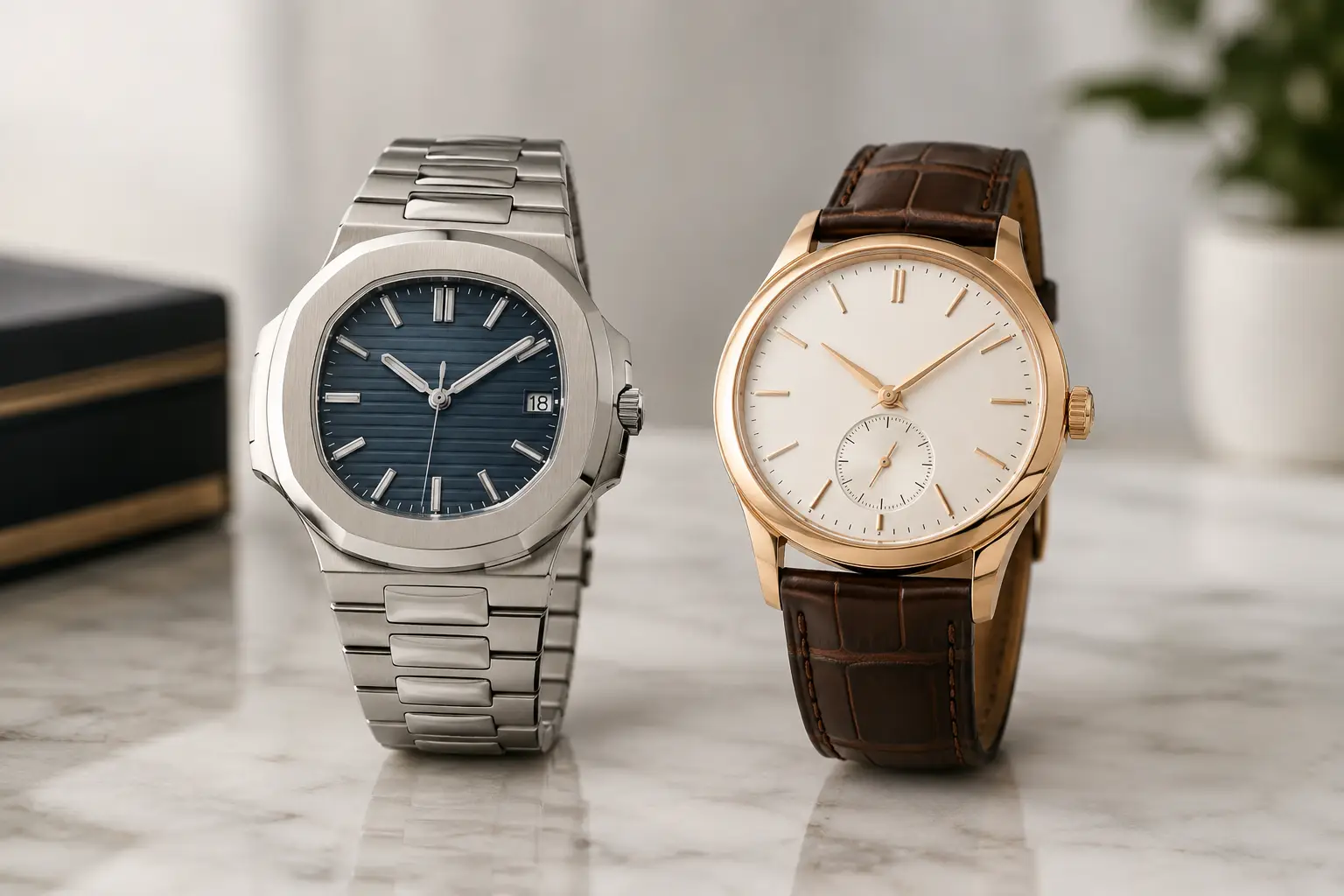
This level of craftsmanship has long been associated with leading maisons, particularly Patek Philippe, Audemars Piguet, IWC, Jaeger-LeCoultre, and Vacheron Constantin. A Patek Philippe perpetual calendar chronograph, for example, is often viewed as a benchmark collector piece because it combines calendar complexity with classical design language and deep manufacture heritage. Audemars Piguet brings the complication into a more assertive sports-luxury setting through select Royal Oak perpetual calendar references.
The right choice depends on what the owner values. A slim precious-metal perpetual calendar may suit formal wear and a traditional collection. An integrated-bracelet model offers a more contemporary expression, though its size, weight, and market demand can create a very different ownership experience.
Reading the Dial Without Guesswork
Perpetual calendar dials can look intimidating at first glance. The information is usually organized around a few essential indications: date, day, month, and moonphase or leap year. Some watches use three subdials, while others use a symmetrical arrangement of apertures and hands.
The visual complexity is part of the attraction, but legibility varies considerably by reference. A highly detailed dial rewards close inspection and feels distinctly technical. A cleaner dial may be easier to read in daily use and more versatile with business or evening attire.
Before purchasing, take time to understand the exact display layout. Confirm which indicator shows the leap-year cycle, whether the calendar uses recessed correctors or crown adjustment, and how the model handles a 24-hour display. That last detail is particularly useful because calendar corrections should generally be made only when the mechanism is outside its changeover period.
Ownership Requires Deliberate Care
A perpetual calendar is designed to be precise, not careless. If the watch stops, it may need every calendar display reset before it can be worn again. On some models, this is straightforward with the supplied corrector tool. On others, especially vintage or highly complicated pieces, professional adjustment is the wiser choice.
Avoid changing the date, day, or month when the mechanism is engaged in its overnight transition. The exact restricted period varies by movement, but changing indications near midnight can place stress on delicate components. Consult the manufacturer instructions for the specific reference rather than relying on a universal time window.
A watch winder can be useful for an owner who rotates several automatic watches and wants to keep a perpetual calendar running. It is not mandatory, and it is not automatically the best choice for every collection. The winder must be compatible with the watch’s recommended rotation settings, and the watch should still receive appropriate servicing.
Service intervals depend on the brand, age, movement condition, and usage. Because calendar work is specialized, choose qualified technicians with experience in high complications and access to proper parts. A lower upfront service quote is not necessarily good value if it compromises originality, water resistance, timing performance, or the integrity of the calendar mechanism.
What to Verify Before Buying
With a perpetual calendar, authenticity and condition deserve more attention than a quick visual inspection can provide. The movement is central to the watch’s value, and an incomplete, over-polished, incorrectly configured, or poorly serviced example can be expensive to correct.
Buyers should verify the reference, serial documentation where applicable, dial and hand originality, case condition, and the proper function of every calendar indication. Ask whether the calendar advances correctly through a full cycle and whether the watch has service history from a qualified source. Original box, papers, corrector tools, and accessories can strengthen collectibility, particularly for sought-after modern references.
Water resistance also deserves a realistic view. A perpetual calendar may carry a water-resistance rating, but a complicated dress watch is rarely the piece to choose for swimming or unguarded exposure to moisture. For most owners, preserving condition takes priority over testing the limits of a precious movement.
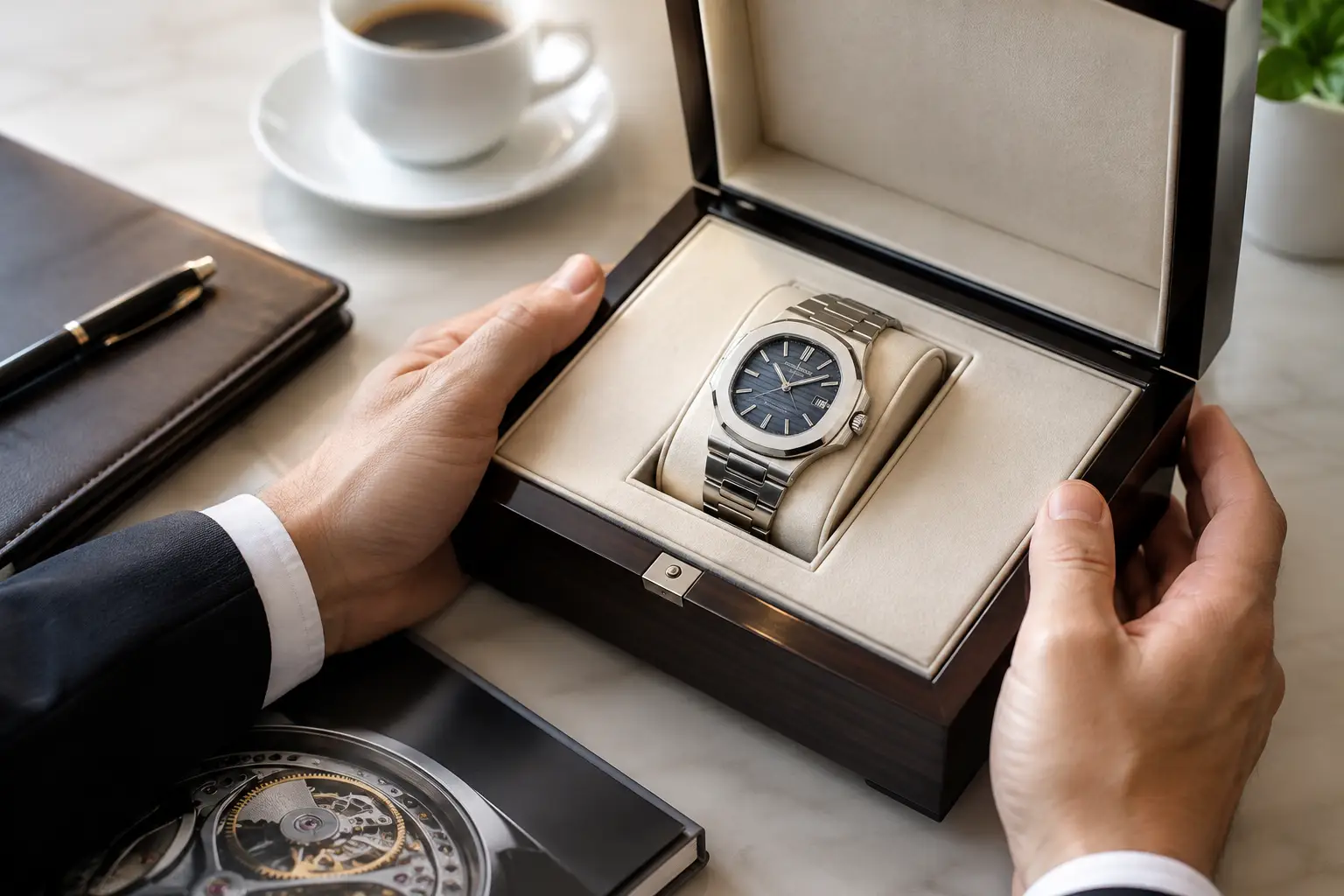
At Lux-Watch, the confidence behind a significant purchase matters as much as the name on the dial. An authenticated luxury watch, thoroughly inspected for condition and performance and supported by clear warranty protection, gives collectors a stronger foundation for acquiring a complicated timepiece online.
Is a Perpetual Calendar Right for You?
A perpetual calendar is ideal for the buyer who wants craftsmanship with a story to tell. It offers more depth than a straightforward time-and-date watch, yet it does not need to be reserved for display. Worn thoughtfully, it can become a defining personal piece: refined under a cuff, compelling in conversation, and mechanically remarkable every time the calendar changes.
The trade-off is responsibility. These watches cost more to buy, can cost more to maintain, and reward careful handling. If effortless daily utility is the priority, an annual calendar or a simple date model may be the better fit. If the appeal is owning one of watchmaking’s most elegant calculations in tangible form, a perpetual calendar delivers a level of prestige that remains meaningful long after the first impression.


Comments are closed