


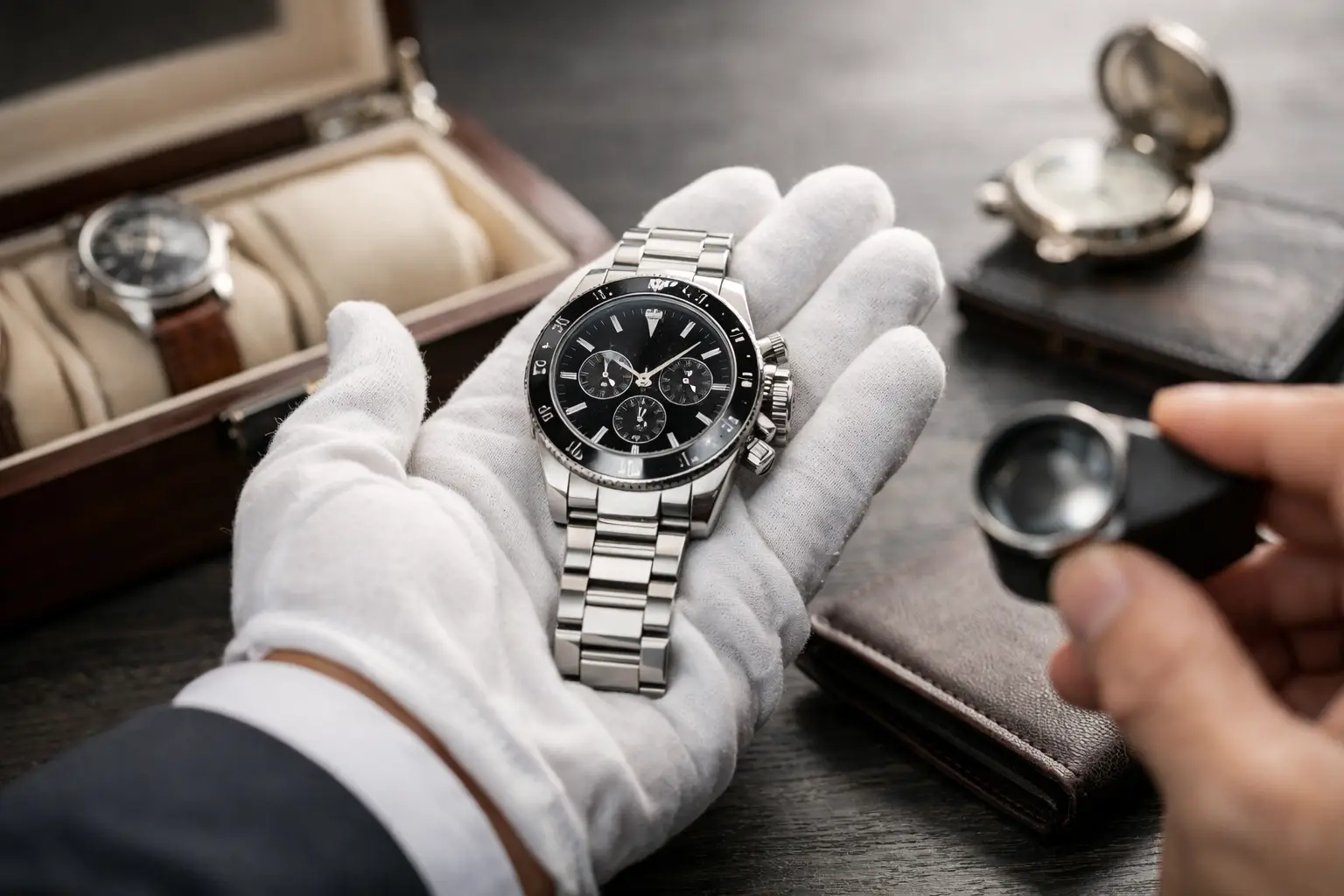
Watch Provenance: Why It Matters Before You Buy
A luxury watch can look flawless in a photograph and still leave serious questions unanswered. Is the reference correct? Has the movement been altered? Do the serial number, papers, and watch align? Watch provenance gives a buyer the documented context behind a timepiece – and, at high values, that context is part of what you are purchasing.
For a Rolex, Patek Philippe, Audemars Piguet, or rare Omega, provenance is not merely collector trivia. It supports confidence in authenticity, explains condition, and can influence long-term desirability. The strongest purchase is one where the watch itself, its documentation, and the seller’s inspection all tell the same story.
What Watch Provenance Really Means
Watch provenance is the record of a watch’s identity and history. It may include its original sale documentation, ownership trail, service records, serial and reference details, original packaging, and any evidence of restoration or component replacement.
The depth of that record depends on the watch. A contemporary full-set Cartier or Breitling may have a warranty card, instruction booklet, presentation box, and purchase receipt. A vintage Panerai or early Speedmaster may have fewer surviving documents, yet still have credible provenance through archival extracts, specialist servicing history, period-correct components, or a well-established collecting history.
Provenance is not the same as authenticity, although the two are closely connected. A watch can be authentic while having limited paperwork. Conversely, a box and warranty card do not automatically prove that the watch paired with them is correct. Proper evaluation considers the complete picture: the watch, its identifiers, its condition, its records, and the source offering it.
Why Provenance Can Affect Value
Luxury watches are designed to endure. Over decades, however, they may be serviced, polished, traded, inherited, or separated from their original accessories. Each event can change how a collector assesses the piece.
A complete set often carries a premium because it offers a more complete ownership experience. The original box, card, booklets, tags, and relevant receipt provide reassurance and make a watch easier to resell. This is particularly meaningful for highly recognizable references such as a Rolex Submariner, Patek Philippe Nautilus, or Audemars Piguet Royal Oak.
That said, a full set should not overpower the fundamentals. An untouched, correct vintage watch with an exceptional dial and case may be more compelling than a heavily restored example accompanied by papers. For collectors, originality and condition can outweigh accessories. For buyers seeking a modern prestige watch, complete documentation and warranty coverage may matter more.
Provenance also protects against expensive misunderstandings. It can reveal whether a watch has undergone factory service, whether its bracelet and clasp are consistent with the reference, and whether a replacement dial, bezel, or handset affects collectibility. None of these details automatically makes a watch undesirable. They simply need to be represented accurately and reflected fairly in the price.
The Records Worth Reviewing Before Purchase
A credible seller should be prepared to discuss the watch beyond its brand name and headline condition. Ask what accompanies the piece and how its identity has been reviewed. The following records are especially useful when available:
- Original warranty card or certificate, with reference and serial information where applicable
- Original box, booklets, hang tags, and purchase documentation
- Service invoices or documentation from an authorized service center
- Archive extracts, insurance records, or prior sale documentation for older or rare pieces
These documents vary in importance. A warranty card generally identifies the watch more directly than a generic box. A recent service invoice can be highly valuable because it may describe work performed and confirm that the movement was examined. Original accessories add appeal, but they should support – not substitute for – close inspection of the watch.
For privacy and security, serial numbers may be partially obscured in online listings. That is normal. Before completing a high-value transaction, buyers should still expect the seller to verify that the watch’s identifying details are correct and that the piece has been reviewed for clean history.
What to Check on the Watch Itself
Paperwork should align with physical details. Start with the reference number, which identifies the model configuration, and the serial number, which helps establish the individual watch. Then consider whether the dial, hands, bezel, bracelet, clasp, and movement are appropriate for that reference and production period.
Condition deserves equally careful attention. A polished case is not inherently a concern, but excessive polishing can soften original edges and alter the lines that define a luxury sports watch. A replacement crystal may be practical and entirely appropriate. A replacement dial on a vintage reference can have a greater effect on collector value. The right answer depends on the model, its age, and what matters to you as the buyer.
Water resistance is another point where provenance and inspection meet. A watch may have been designed for diving or daily wear, but age, service history, and gasket condition affect current performance. A trustworthy sales process should distinguish between a watch’s original specification and its tested condition at the time of sale.
Provenance for Modern Watches vs. Vintage Watches
Modern luxury watches are usually more straightforward to document. Their cards, serial formats, packaging, and service records are more likely to remain intact. Buyers of newer Rolex, Omega, or Hublot models often prioritize a complete set, documented condition, and active warranty protection.
Vintage watches require more nuance. Missing papers are common and should not automatically discourage a purchase. A watch from the 1960s or 1970s may have changed hands privately long before collectors treated packaging as valuable. In these cases, the quality of the watch’s components, the credibility of the seller, and the consistency of its known history become especially important.
Limited editions sit somewhere in between. Their certificates, numbered cases, special packaging, and production documentation can materially strengthen desirability. Yet even here, condition remains decisive. A limited-edition watch with complete accessories but incorrect parts deserves more scrutiny than a well-preserved example with a modestly incomplete set.
Questions That Create Buyer Confidence
Before purchasing, ask direct questions. Is the watch accompanied by its original box and papers? Has it been serviced, and by whom? Are all major components original to the watch? Has it been inspected for authenticity, accuracy, water resistance, and condition? Is warranty protection included?
Clear answers are a sign of a professional transaction. Vague claims such as “looks original” or “comes as shown” are not enough for a significant purchase. A premium watch seller should describe what is known, identify what is not documented, and stand behind the watch with meaningful inspection and warranty standards.
This is where buying from a trusted luxury specialist differs from taking a chance on an unverified private listing. The right retailer does not ask you to interpret incomplete information alone. It provides a carefully presented watch, confirms its authenticity, and gives you a defined basis for confidence after the sale. Lux-Watch applies that standard to every timepiece it offers, with inspection focused on accuracy, water resistance, condition, and clean history.
Provenance Is Part of the Ownership Experience
A watch with strong provenance is easier to enjoy. You know what you own, what has been done to it, and which details make it distinctive. If you later decide to gift, insure, trade, or sell the timepiece, that clarity remains valuable.
Do not assume that every exceptional watch must include every original accessory. Instead, look for a fair match between the watch’s age, condition, documentation, and price. Choose the piece whose story is clear enough for your standards – then wear it with the confidence that should come with genuine luxury.



Comments are closed